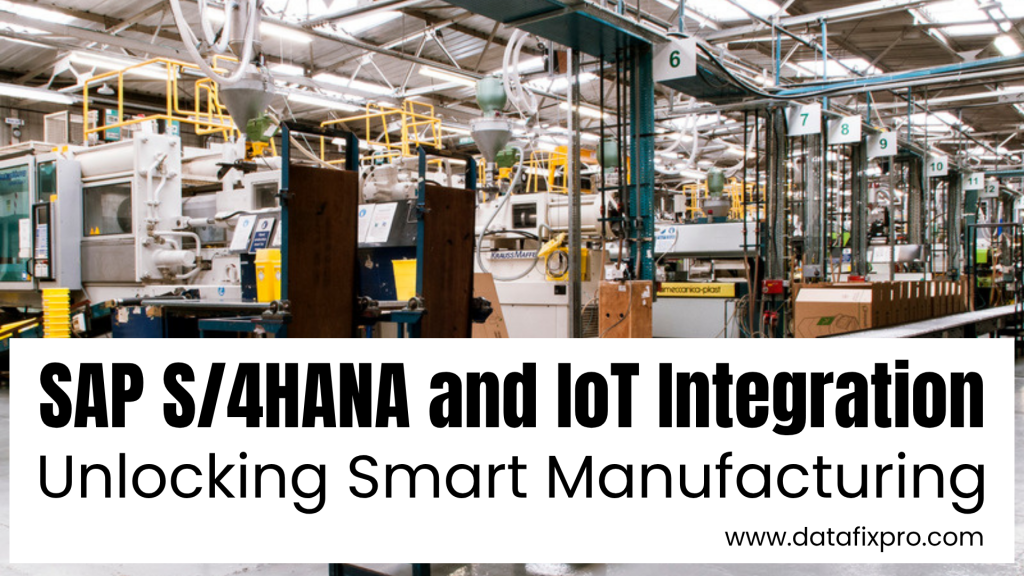

SAP S/4HANA and IoT integration is helping manufacturers build more connected and responsive production environments. IoT devices collect real-time data from machines, equipment, and production lines, while SAP S/4HANA connects that information with core business processes.
Manufacturers can therefore move beyond traditional systems that rely heavily on manual data collection. Instead, real-time operational information can support production planning, maintenance, inventory, and decision-making.
This connection is an important step toward smart manufacturing.
How SAP S/4HANA and IoT Work Together
IoT devices collect information directly from the physical environment. Sensors can monitor machine temperature, vibration, energy consumption, production activity, and other operational conditions.
SAP S/4HANA provides the enterprise system needed to connect this information with business processes.
The basic flow is:
Machine → IoT Sensor → Real-Time Data → SAP S/4HANA → Business Action
As a result, manufacturers can connect what is happening on the production floor with the systems used to manage the wider business.
Key Benefits of Integration
| Manufacturing Area | Potential Benefit |
|---|---|
| Production | Better visibility into operations |
| Maintenance | Earlier detection of equipment issues |
| Inventory | More accurate material information |
| Quality | Faster identification of production issues |
| Energy | Better monitoring of consumption |
| Decision-Making | More current operational data |
The exact benefits depend on the manufacturing environment, existing systems, and selected IoT use cases.
Improving Production Visibility
Manufacturing operations can change quickly. A machine may slow down, production output may change, or equipment may require attention.
IoT sensors can capture these changes in real time. When the information is connected with SAP S/4HANA, production teams can gain a clearer view of current operations.
For example, managers can monitor machine performance alongside production information instead of relying only on periodic reports.
Consequently, teams can identify operational changes earlier and respond more quickly.
Supporting Predictive Maintenance
Equipment failure can create unexpected downtime and disrupt production schedules.
IoT sensors can monitor machine conditions such as vibration, temperature, and pressure. Unusual patterns may indicate that equipment requires inspection or maintenance.
When this information is connected with SAP S/4HANA, maintenance data can be managed alongside other business processes.
For example:
Sensor detects abnormal condition → Data is analyzed → Maintenance activity is planned → Equipment is inspected
This approach can help manufacturers move from reactive maintenance toward a more proactive strategy.
Read more about this topic in The Role of IoT in Predictive Maintenance and Cost Reduction.

Better Inventory and Material Management
Smart manufacturing also depends on having the right materials available at the right time.
IoT devices can track inventory movement, equipment usage, and material consumption. SAP S/4HANA can then connect this operational information with inventory and procurement processes.
For instance, real-time consumption data can help teams understand when production materials are being used faster than expected.
As a result, manufacturers can improve visibility and make more informed inventory decisions.
For a broader view, read IoT in Supply Chain Management: Improving Visibility and Accuracy.
Enabling Faster Decision-Making
Real-time data is valuable because manufacturing decisions often need to happen quickly.
Instead of waiting for information to be manually collected and reported, connected systems can provide operational updates as events occur.
Manufacturers can use this information to evaluate:
- Machine performance
- Production output
- Material consumption
- Equipment conditions
- Energy usage
- Operational efficiency
Therefore, decision-makers can combine real-time operational information with business data from SAP S/4HANA.
Creating a More Automated Factory
Integration between SAP S/4HANA and IoT can also support automation.
For example, an IoT sensor can detect a specific machine condition and trigger an alert or workflow. This reduces the need for employees to manually monitor every operational event.
A connected process might look like this:
IoT detects event → SAP S/4HANA receives relevant data → Workflow is triggered → Team takes action
Over time, these connected workflows can help reduce repetitive tasks and improve operational consistency.
Getting Started With Smart Manufacturing
Manufacturers do not need to connect every machine at once.
A practical approach is to begin with a specific operational challenge, such as equipment downtime, production visibility, or energy consumption.
A simple implementation process includes:
- Identify a high-value manufacturing problem.
- Determine which operational data is needed.
- Connect the relevant machines or assets.
- Integrate the data with SAP S/4HANA.
- Measure the operational impact.
- Expand to additional use cases.
Starting with a focused use case can make the implementation easier to manage and measure.
Conclusion
SAP S/4HANA and IoT integration creates a connection between real-time production data and enterprise business processes.
IoT provides visibility into machines, equipment, and production environments. SAP S/4HANA can then connect this information with processes such as production, maintenance, inventory, and procurement.
Together, these technologies can help manufacturers build more connected, responsive, and data-driven operations.
Smart manufacturing is not simply about adding more connected devices. It is about turning real-time operational data into meaningful business actions.
Build a Smarter Manufacturing Operation
Ready to connect your production data with your enterprise systems?
Datafixpro helps businesses integrate SAP, IoT, ERP, and digital technologies to create smarter and more efficient operations.
Talk to Our SAP & IoT Experts →wa.me://6285101762221