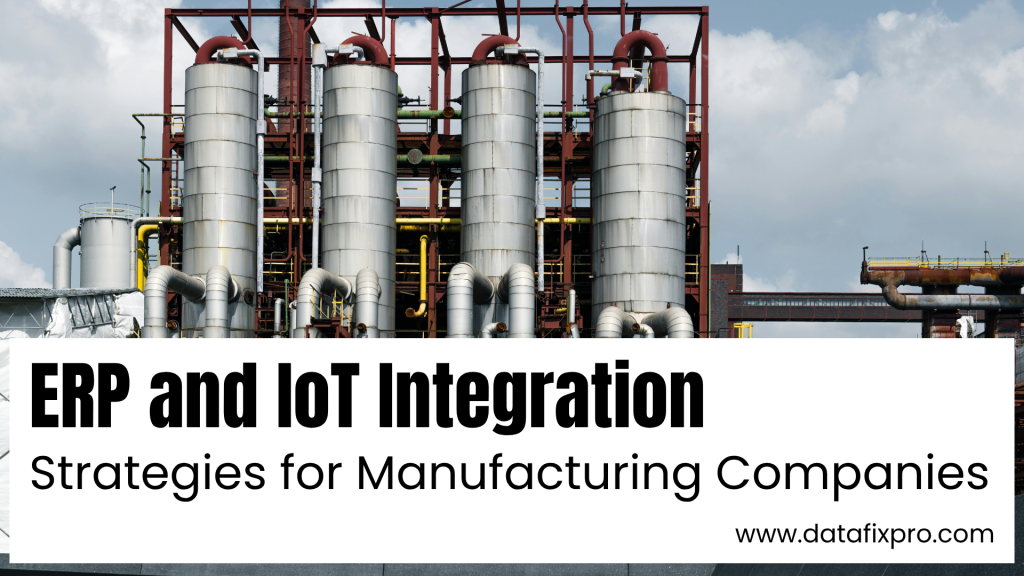

ERP and IoT integration is helping manufacturing companies connect real-time operational data with core business processes. IoT devices collect information from machines, production lines, and equipment, while ERP systems help businesses use that information across their operations.
However, simply connecting devices is not enough. Manufacturers need a clear strategy to make sure IoT data supports real business needs.
With the right approach, ERP and IoT can improve visibility, reduce manual work, and help teams respond faster to operational changes.
Why Connect IoT With ERP?
IoT provides real-time information from the physical environment. ERP, meanwhile, manages processes such as production, inventory, procurement, maintenance, and finance.
When these systems work together, information can move more smoothly between the factory floor and business operations.
A typical flow looks like this:
Machine → IoT Sensor → Real-Time Data → ERP → Business Action
As a result, manufacturers can make decisions based on current operational conditions rather than relying only on manual reports.
Key Benefits for Manufacturers
| Area | Potential Benefit |
|---|---|
| Production | Better visibility into machine performance |
| Maintenance | Earlier detection of equipment issues |
| Inventory | More accurate material information |
| Quality | Faster identification of production problems |
| Energy | Better monitoring of resource consumption |
| Reporting | Less manual data collection |
These benefits can support both operational efficiency and better decision-making.
1. Start With a Clear Manufacturing Problem
The first step is not choosing technology. It is identifying the problem that needs to be solved.
For example, a manufacturer may struggle with:
- Unexpected machine downtime
- Inaccurate inventory records
- Manual production reporting
- Limited equipment visibility
- High energy consumption
Once the problem is clear, the company can determine which IoT data and ERP processes need to be connected.
This approach helps prevent unnecessary technology investments.
2. Connect the Right Machines and Data
Manufacturers do not need to connect every machine immediately.
Instead, start with equipment that has a significant impact on production or operational costs.
IoT sensors can collect information such as:
- Temperature
- Vibration
- Machine runtime
- Energy consumption
- Production output
The collected data can then be connected to relevant ERP processes.
For example, machine runtime data could support maintenance planning, while production data could help improve production reporting.
3. Integrate Data With ERP Processes
Collecting IoT data is only one part of the process. The information needs to be useful within the ERP environment.
For example:
Machine data → ERP maintenance record → Maintenance team → Action
Similarly:
Material movement → IoT detection → ERP inventory update → Current stock information
This integration reduces the gap between what happens on the factory floor and what appears in business systems.
4. Use Real-Time Data for Predictive Maintenance
Equipment failure can cause production delays and unexpected costs.
IoT sensors can monitor machine conditions and identify unusual patterns. When connected with ERP maintenance processes, this information can support earlier inspections and maintenance activities.
Instead of waiting for equipment to fail, teams can investigate potential problems sooner.
Learn more in The Role of IoT in Predictive Maintenance and Cost Reduction.
5. Improve Inventory and Supply Chain Visibility
Manufacturing operations depend on accurate information about materials and inventory.
IoT devices can track material movements throughout warehouses and production areas. ERP systems can then use this information to maintain more accurate inventory records.
As a result, purchasing and production teams can work with more reliable information.
This is particularly useful for manufacturers dealing with large volumes of materials or complex supply chains.
Read more about this approach in IoT in Supply Chain Management: Improving Visibility and Accuracy.
Making the Integration More Effective
Successful integration is not only about technology. Data quality, system compatibility, security, and employee adoption also matter.
Manufacturing companies should therefore consider:
- Data quality: Is the IoT data accurate and consistent?
- System compatibility: Can the devices communicate with the ERP?
- Security: Is operational data properly protected?
- Scalability: Can the solution grow with the business?
- User adoption: Can employees easily use the new processes?
A well-planned implementation can make it easier to expand IoT across additional production areas later.
Conclusion
ERP and IoT integration can help manufacturing companies connect real-time operational data with essential business processes.
IoT provides visibility into machines, equipment, and production activities. ERP then provides the structure needed to turn that information into useful business actions.
The best strategy is not necessarily to connect everything at once. Instead, manufacturers can start with a specific problem, measure the results, and gradually expand the solution.
Ultimately, successful integration is about creating a stronger connection between machines, data, people, and business decisions.
Build a More Connected Manufacturing Operation
Looking to connect your manufacturing operations with ERP and IoT?
Datafixpro helps businesses integrate ERP, SAP, IoT, and digital solutions to improve visibility, automation, and operational efficiency.